
Why does wood crack? It is a question everyone asks when they notice a fine line on a new chopping board or a split in a wooden bowl. Wood is a living material that constantly reacts to the humidity and temperature around it – and these changes are at the root of most cracks. In this guide we explain why cracking happens and, above all, how to prevent it with simple care.
Wood is alive, even when it is no longer a tree
Even long after the tree has ended up in a joiner's workshop, the wood keeps its porous structure. Microscopic capillaries remain inside the fibres and continue to absorb and release moisture from the surrounding air. This phenomenon is called hygroscopicity – and it is the main reason why wood behaves differently in summer and in winter, and differently next to the kitchen cooker than in the living room.
When the humidity in the air drops, wood releases moisture and shrinks. When the humidity rises, wood absorbs it and swells slightly. The problem arises when this process happens too quickly or unevenly – for example when a product has one side next to a radiator and the other in a cold corner of the room. The surface loses moisture sooner than the core, the fibres pull with different forces, and the tension is released in the only way possible – as a crack.
With quality wooden home accessories made from slowly dried Czech wood, the risk of cracking is much lower than with industrially dried materials. Even so, even the best wood appreciates sensible handling.
🌳 Looking for wooden products that last? At AMADEA you will find handmade products from Czech forests, for which we take care to dry the wood carefully and give it a quality finish.
Visit AMADEAThe main causes of cracking in wood
Not all cracks have the same origin. If you want to help your wood effectively, it is good to know the individual triggers – they usually act in combination.
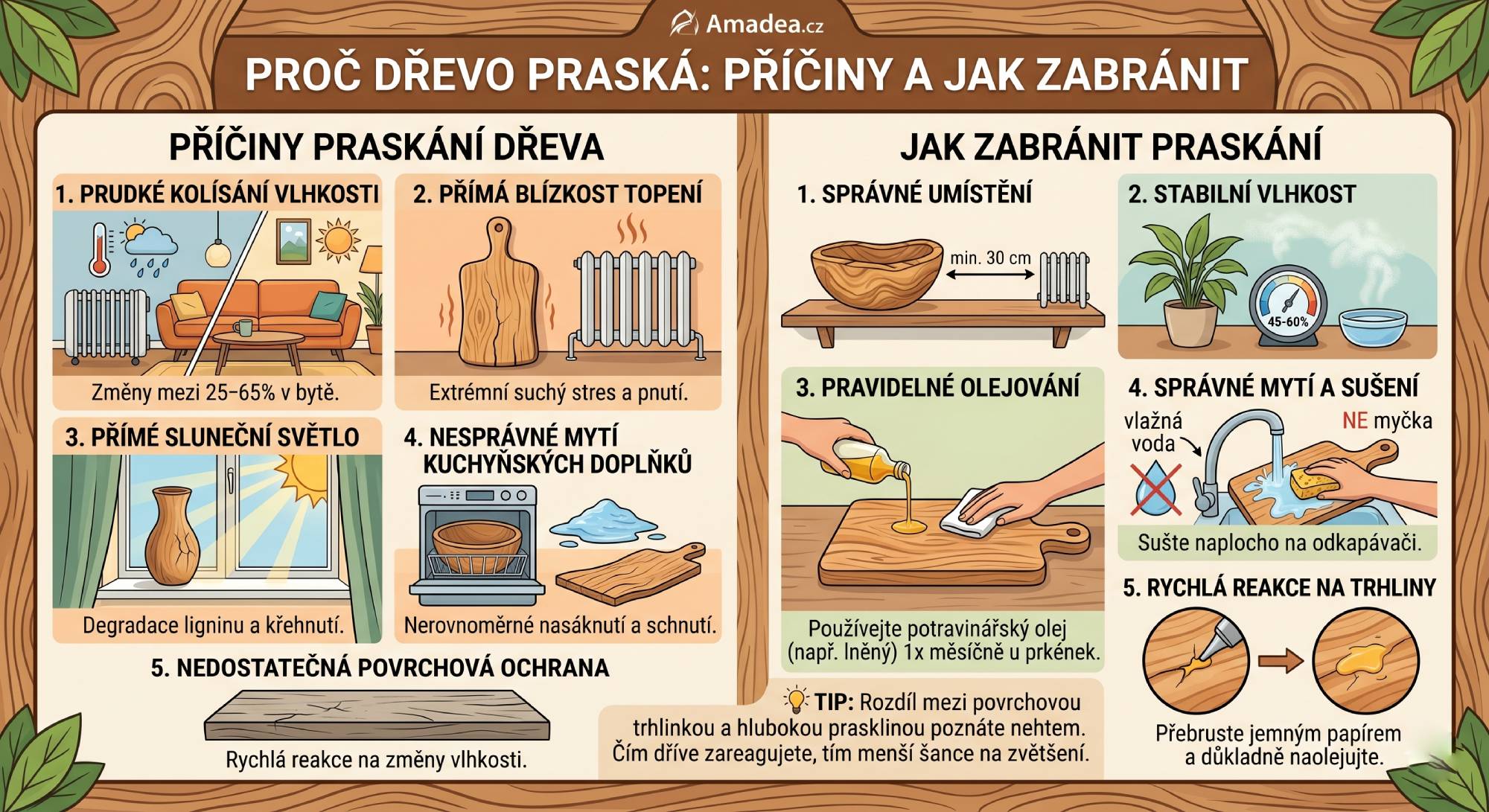
1. Sharp fluctuations in air humidity
The most common culprit. In summer a Czech flat typically has a humidity of 55–65 %, while in the heating season it can easily fall to 25–30 %. This difference is a huge shock for wood. The fibres shrink in winter and swell in summer – and if this cycle repeats for many years without treatment, first micro-cracks and then visible cracks appear. The solution is to keep the humidity in the room stable between 45 and 60 % – ideally with a humidifier in winter and good ventilation in summer.
2. Close proximity to a radiator, fireplace or cooker
A wooden clock hung above a radiator, a fruit bowl next to the cooker, a candle holder on the mantelpiece – these are all places where wood suffers extreme drying stress. The temperature there can exceed 40 °C and relative humidity can fall below 20 %. The wood starts to dry out quickly from the surface while the core stays moister – the result is the classic lengthwise crack along the grain.
3. Direct sunlight and UV radiation
The sun not only dries wood out but also degrades the lignin in the surface fibres. The product first fades, then becomes more brittle, and eventually fine web-like cracks appear (so-called "cobweb" cracks). This mainly affects products on windowsills, by glazed balcony doors or on terraces and in gardens – for example wooden planters and flower pots that spend the whole summer in direct sun.
4. Washing kitchen accessories incorrectly
Chopping boards, bowls and spoons deserve a chapter of their own. If you submerge them in the sink, leave them lying in a puddle of water or even put them in the dishwasher, the wood absorbs water unevenly and the fibres swell – and as it dries again it shrinks so sharply that it splits. So wash kitchen chopping boards by hand in lukewarm water, dry them straight away and always dry them flat so that both sides are aired equally.
5. Insufficient surface protection
All solid wood needs "nourishment" from outside. Oil, wax or a wood impregnator creates a flexible layer that slows down the exchange of moisture between the wood and its surroundings. When this layer is missing or worn, the wood reacts immediately to every change in humidity – and rapid reactions are exactly what leads to cracks.
💡 Tip: You can easily tell the difference between a fine surface crack and a deep through-crack – run your fingernail across the spot. If your nail doesn't catch, it is a cosmetic issue that oil will even out. If it "drops" into the crack, it is time for a more expert repair.
How to prevent cracking – step by step
The following procedure works for all wooden products – from kitchen chopping boards and wooden clocks and candle holders to furniture and decorations. Only the frequency of care differs.
Before you start: You will need a soft cotton cloth (an old T-shirt works perfectly), fine sandpaper (240–320 grit) for any repairs, food-safe oil (for kitchen accessories) or linseed oil (for decorations and furniture) and patience – oil is absorbed slowly and gives the best results when you give it time to work.
Step 1: Find the right place for the wood
Before you reach for the oil, start with the location. The product should be no closer than 30 cm to a radiator, should not stand in a constant draught (an open window in winter plus a door to the hallway) and should not be in direct sunlight all day. If you can't avoid these places, expect more intensive care – you will need to oil 2–3 times more often.
Step 2: Keep the humidity in the room stable
In the heating season the humidity in Czech flats often drops to 25 %, which is a borderline value for wood. Conventional humidifiers help, but home remedies work too – a bowl of water on the radiator, houseplants, drying laundry in the living room. To keep an eye on it, it is worth buying an inexpensive hygrometer (approx. €10–20) and keeping the values between 45 and 60 %.
Step 3: Oil the surface regularly
Oiling is the most effective prevention. The procedure is simple:
First wipe the surface with a slightly damp cloth and let it dry completely. Put a small amount of oil on a clean, dry cloth (a teaspoon is enough for an A4-sized board) and rub it in with circular movements along the grain. Let the oil soak in for 15–30 minutes and gently wipe off the excess with the clean side of the cloth. With a new product or a dried-out piece, repeat the process 2–3 times at half-day intervals – the wood "drinks" thirstily.
Frequency: for chopping boards and frequently used utensils about once a month, for decorations and clocks 2–4 times a year, for furniture 1–2 times a year depending on exposure.
💡 Which oil to choose: For kitchen accessories use only food-safe oil – ideally a special clear wood oil intended for food contact. Avoid ordinary kitchen oils such as olive or sunflower oil, which can go rancid over time. For decorations and furniture, polymerised linseed oil or a special furniture wax is ideal.
Step 4: Wash and dry correctly
Never soak kitchen wood, never leave it lying in the sink and on no account put it in the dishwasher. After use, rinse it in lukewarm water or gently wipe it with a sponge and a drop of washing-up liquid, dry it immediately with a tea towel and let it finish drying flat on the draining rack – definitely not propped against the wall, where one side would dry faster than the other.
Step 5: Act at the first sign of a crack
If you notice a small line, don't wait. Sand the spot with fine sandpaper (240 grit or finer) along the grain, wipe off the dust with a dry cloth and thoroughly rub oil or warmed beeswax into the crack. The fibres swell and the crack visually closes. The sooner you act, the smaller the chance it will crack further.
⚠️ The most common mistakes to avoid: Never put wood in the dishwasher (hot water + aggressive detergent = guaranteed cracks). Don't leave a board to dry propped against the wall. Don't use vegetable oils that go rancid (such as olive or sunflower oil). Don't place products directly above a radiator or fireplace. And above all – don't dry cracked wood quickly in the sun or by the heater; that will only make things worse.
Which wood cracks the most – and which the least?
Not all wood species react to changes in their environment in the same way. The table gives an overview of the most common Czech woods used in handcrafted production.
| Wood species | Tendency to crack | Suitable uses |
|---|---|---|
| Oak | Low | Chopping boards, furniture, outdoor decorations |
| Ash | Low | Kitchen utensils, bowls, chopping boards |
| Beech | Medium | Kitchen, decorations, toys |
| Maple | Low to medium | Chopping boards, bowls, small decorations |
| Birch | Medium | Decorations, lighter items |
| Spruce / pine | Higher (resin) | Decorations, planters, ornaments |
| Walnut | Low | Luxury products, jewellery, decorations |
Products by Czech craftspeople are most often made from beech, oak and ash – woods with reasonable stability and a long tradition in our country. For wooden bowls or kitchen utensils, the choice of species is crucial precisely because of resistance to moisture.
Frequently asked questions about cracking wood
Is it normal for a wooden product to crack over time?
Small surface cracks are natural in solid wood – wood is a living material that reacts to humidity and temperature. Deep cracks, however, signal that the wood is drying out too quickly or is in an unsuitable environment. With the right care, cracking can usually be eliminated entirely.
Why does wood crack right next to a radiator?
A radiator creates a local dry zone with humidity below 30 %. The wood loses moisture from the surface faster than from the core, the fibres shrink unevenly and tension builds up, which is released as a crack. The solution is to move the product at least 30 cm away from the heater and humidify the air in the room.
How often should I oil a wooden chopping board?
For a frequently used board, once a month is enough; for less used products 2–4 times a year. If the wood looks dry and dull, or darkens quickly after rinsing and then turns pale again, it is high time for oil.
Can cracked wood be repaired?
Surface cracks can be closed with oil or beeswax – the fibres soak it up, swell and the crack visually closes. Deep through-cracks in kitchen items (chopping boards, bowls), however, call for replacement – dirt gets into the crack and it can't be cleaned hygienically.
How should I care for AMADEA wooden products so they don't crack?
Products from AMADEA are made from Czech wood that has already undergone slow natural drying, so the risk of cracking is minimal. Just don't place them directly above a heater, don't expose them to direct sunlight, oil kitchen accessories regularly with food-safe oil and wash them by hand in lukewarm water. That way you will avoid even small surface cracks.
🌳 Want wooden products that last for generations? At AMADEA we make them by hand from slowly dried Czech wood – from kitchen chopping boards and decorations to custom-made gifts.
Browse the rangeAuthor: Martin Portych – specialist in wooden products, gift advice and shop content
Editorial policy: Our content is based on the day-to-day practice of the AMADEA shop, the real needs of our customers and a commitment to clear, useful and trustworthy information.