
The forest animals of Czechia are among the most beautiful treasures of our nature – from the majestic red deer and the nimble roe deer to the clever wild boar and the fox. The Czech forest is home to dozens of species of mammals and birds, and knowing them enriches every walk in the countryside. Test how well you know Czech forest wildlife in our interactive game, then read the detailed guide to the most common species.
Identification quiz: Czech forest wildlife
Choose a difficulty level and find out whether you would recognise a red deer in the wild – or only on your plate. 🦌
🌳 Looking for a gift made of natural wood? At AMADEA you will find handmade products from Czech forests – from decorations to kitchen accessories.
Visit AMADEAA guide to Czech forest wildlife
Get to know in more detail six of the most characteristic species you can meet in Czech forests – from the Šumava and the Krkonoše to the Moravian Karst.
Red deer (Cervus elaphus)

The red deer is the largest hoofed game animal in Czechia. An adult stag reaches a shoulder height of 150–160 cm and weighs 120–240 kg. The female (hind) is roughly a third smaller. The characteristic feature is the stag's mighty antlers, which are shed every year at the end of winter and grow again in spring, covered in a protective velvet. Two populations live in Czechia – the Central European red deer in Bohemia and Moravia and the more massive Carpathian red deer in eastern Moravia.
The red deer rut peaks in September. Stags then give loud roars that can be heard kilometres away and fight for a harem of hinds. During this time stags can lose a quarter of their body weight. After the rut, the stags gather in herds separate from the hinds. The young (calves) are born from late May to June with a pale spotted coat that disappears after three months. The best chance of seeing red deer is at dusk in forest clearings – for example in the Ore Mountains (Krušné hory), the Šumava or the extensive forests of the Vysočina highlands.
Roe deer (Capreolus capreolus)

The roe deer is the most numerous member of the deer family in Czechia – you can meet it practically everywhere, from the lowlands to mountain forests at around 1,400 m above sea level. It weighs 15–30 kg and has a body length of about 110–130 cm. The buck usually has antlers with three tines on each side (a "six-pointer"), which he sheds in November and which regrow by spring. Unlike red deer, roe deer live alone or in small family groups for most of the year.
The roe deer rut takes place in July and August – much earlier than that of red deer. Bucks chase does in distinctive circles, so-called "roe rings", which can be seen in the wild as trampled circles in the grass. Although the actual pregnancy lasts only about five months, the fertilised egg remains dormant from August to December (embryonic diapause) – so the young are not born until May. The fawns (usually two) are camouflaged with a white-spotted coat for the first weeks and lie quietly hidden in the grass. When alarmed, roe deer give a sharp, barking alarm call.
Wild boar (Sus scrofa)

The wild boar is an intelligent and adaptable species whose numbers in Czechia have risen sharply in recent decades. An adult male (boar) weighs 80–200 kg and exceptionally even more than 250 kg. The female (sow) is smaller. The boar is equipped with strong tusks, which he uses in fights and for rooting. Wild boar are social animals – they live in groups (sounders) led by an experienced sow with her piglets. Males older than three years mostly live alone.
In the Czech landscape, wild boar prefer mixed forests with bramble thickets close to water. They are excellent swimmers and cross rivers without difficulty. They eat acorns, beechnuts, roots, insects, worms, birds' eggs and carrion – they are true omnivores. In fields they cause damage by rooting, mostly at night. Piglets have a typically striped coat, which changes to a uniform brown-black during their first year. Wooden decorations with a wild boar motif are a popular gift for hunters and forest lovers.
Red fox (Vulpes vulpes)

The red fox is the most widespread carnivore and the most common member of the dog family in Czechia. It lives practically everywhere – in forests, farmland and on the edges of towns. It weighs 4–10 kg and its body length (without the tail) is 50–90 cm. Typical features are its russet-orange coat, white markings on the throat and face and a bushy tail (brush) with a white tip. It gives a characteristic piercing scream, especially during the mating season in January and February.
The fox is nocturnal, but when disturbed or short of food it also hunts by day. It is an omnivore – it catches mice, rabbits, birds and their eggs and collects insects, frogs and fruit. In urban areas it raids rubbish bins. It digs its dens in sandy or loamy slopes and also uses abandoned badger setts. The fox is the main carrier of rabies in Europe, which is why oral vaccine baits are dropped from aircraft every year. In Czechia, the hunting season for foxes runs from 1 July to the end of February.
European badger (Meles meles)

The European badger is the largest member of the weasel family (mustelids) in Czechia and one of the most social. It weighs 8–18 kg and is characterised by a black-and-white striped pattern on its head – a dark stripe runs from the snout over each eye to the ears. The strong claws of its front paws are adapted for digging; badgers build extensive underground burrow systems (setts, sometimes called "forest castles"), which are passed down from generation to generation and can have dozens of entrances.
In Czechia badgers sleep only during the coldest months (December–February) – their sleep is not true hibernation, just a deep winter rest. They are omnivores: they hunt earthworms, insects, small mammals and frogs and gather berries, roots and grain. In the warm months they are active only after dark. Badgers are social and live in clans of 5–15 individuals sharing one sett. Mating takes place in summer, but thanks to embryonic diapause the cubs are not born until February. In the forests of the Brdy hills, the White Carpathians or the Ore Mountains, badger setts are relatively easy to find.
Eurasian lynx (Lynx lynx)
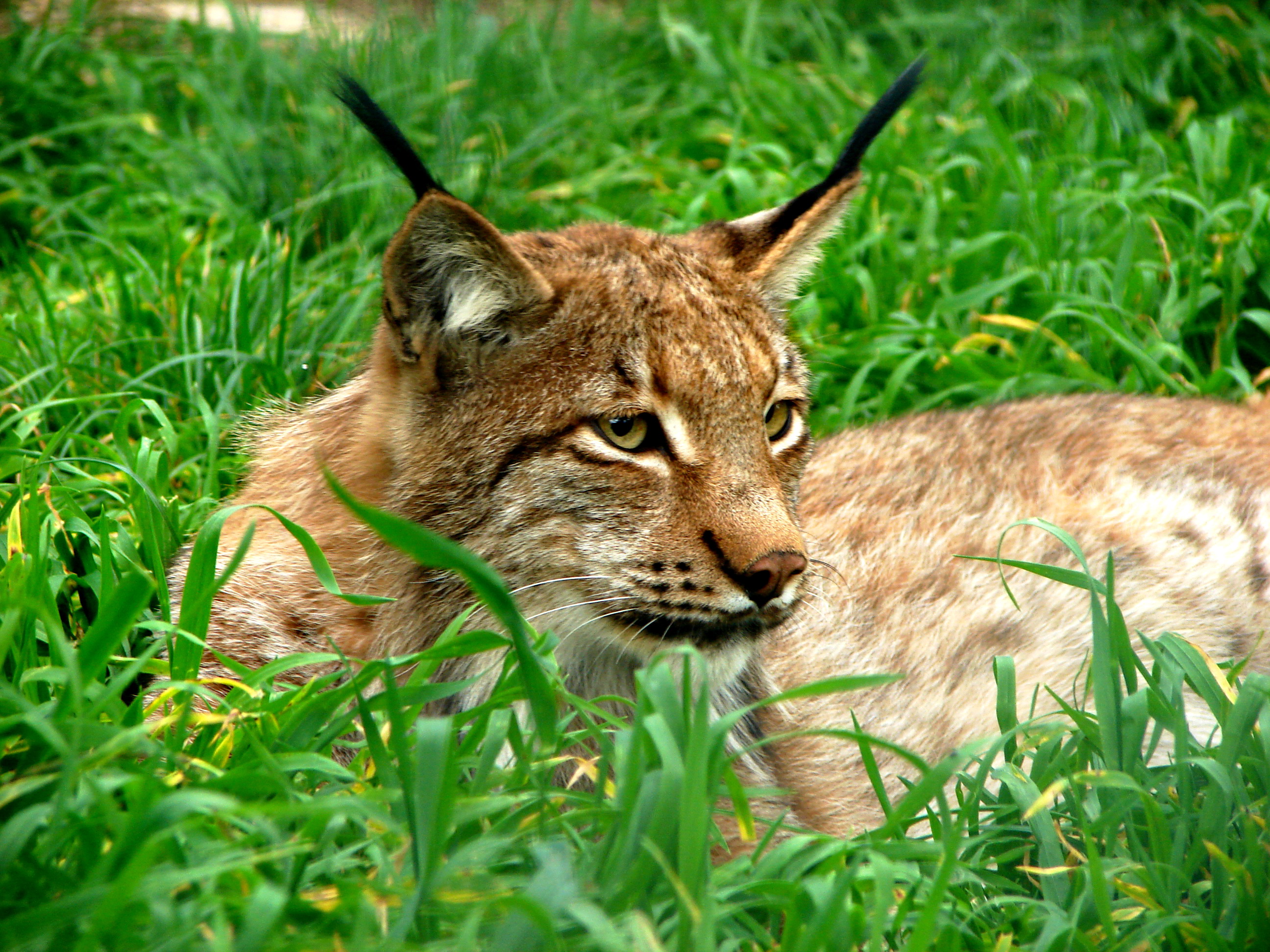
The Eurasian lynx is the largest wild cat in Europe and also the most endangered large predator in Czechia. It weighs 18–30 kg with a body length of 80–130 cm. Typical features are its spotted coat (varying from yellowish-brown to grey), a short tail with a black tip, tufted ears and striking facial ruffs. In Czechia it occurs mainly in the Šumava, the Bohemian Forest, the Jeseníky mountains and the Beskydy, where successful reintroductions took place.
The lynx is solitary and hunts mainly at night. Its main prey is roe deer, supplemented by hares, foxes and birds. It waits in ambush and usually pounces from very close range – it is a sprinter, not an endurance runner. The lynx is strictly protected by law and may not be hunted in Czechia. The population in the border mountains is estimated at 70–100 individuals; reintroductions have taken place since the 1970s. Lynx are sensitive to landscape fragmentation – motorways and railways act as barriers for them. Meeting a lynx in the wild is an exceptional experience that many foresters and hikers have only once in a lifetime.
The most common mix-ups and mistakes in identifying forest wildlife
Even experienced hikers confuse some species. Here are the three most common mistakes.
Comparison table of Czech forest wildlife
| Species | Weight | Habitat | Activity | Protection |
|---|---|---|---|---|
| Red deer | 120–240 kg | Forests, clearings | Dusk, night | Game species |
| Roe deer | 15–30 kg | Forests, fields, gardens | Dawn, dusk | Game species |
| Wild boar | 80–200 kg | Forests, fields | Night | Game species |
| Red fox | 4–10 kg | Everywhere, even towns | Night, dusk | Game species |
| European badger | 8–18 kg | Forests, orchards | Night | Game species |
| Eurasian lynx | 18–30 kg | Mountains, dense forest | Night | Strictly protected |
Frequently asked questions about Czech forest wildlife
What animals live in Czech forests?
Czech forest wildlife includes dozens of species. The most common mammals include the roe deer, red deer, wild boar and red fox. Among rarer carnivores, you may meet the Eurasian lynx in border areas, and in some places the wolf or even the brown bear, which come to Czechia from neighbouring countries.
When does the red deer rut take place in Czechia?
The red deer rut in Czechia peaks in September; it begins at the end of August and lasts until October. During this time stags give their characteristic roars, heard mainly at dawn and dusk. The rut is best observed on forest edges in the Vysočina region, the Ore Mountains or the Šumava.
How does a roe deer differ from a red deer?
The main difference is size – a red deer is roughly four times heavier than a roe deer. A roe buck has simple antlers with at most three tines, while a red stag carries massive branched antlers. The roe deer rut also takes place in summer (July–August), whereas the red deer rut is in autumn (September–October).
Is wild boar dangerous to people in the forest?
Wild boar usually avoid people and do not attack of their own accord. A sow defending her piglets can be dangerous – in that case stay calm, never get between the sow and her piglets and slowly move away. Males can be aggressive during the rut (October–January). Never feed wild boar and never take away seemingly abandoned piglets.
Where can I find wooden decorations with forest animal motifs?
You will find handmade wooden decorations featuring deer, foxes and other forest animals at AMADEA. We make them in the Czech Republic from native woods – oak, lime and beech. They make an ideal gift for men, hunters and nature lovers, and we also offer wooden puzzles with nature motifs.
🌳 Looking for a gift made of natural wood? At AMADEA you will find handmade products from Czech forests – from decorations to kitchen accessories.
Visit AMADEAAuthor: Martin Portych – specialist in wooden products, gift advice and shop content
Editorial policy: Our content is based on the day-to-day practice of the AMADEA shop, the real needs of our customers and a commitment to clear, useful and trustworthy information.