
Tree bark is like a fingerprint – every species has its own. Can you tell whether you are walking past an oak, a beech or a birch without looking up at the branches and leaves? Bark reveals more than you might think: the tree's age, its health and what kind of wood it hides inside. This page will help you learn to recognise the bark of Czech forest trees – from the fairy-tale silver birch and the majestic English oak to the spruce, which underpins most of Czech forestry.
🌳 Interactive game: Can you identify a tree by its bark?
Put your knowledge to the test in our bark identification game. Three difficulty levels, a pool of 36 questions and a fun fact on every card.
🪵 Do you love nature and natural materials? At AMADEA you will find handmade wooden products from Czech forests – from solid beech chopping boards to decorations made from local woods.
Visit AMADEAA guide to the bark of Czech forest trees
Learning to identify a tree by its bark may seem difficult, but with a little attention anyone can do it. Below you will find eight of the most common trees in Czech forests – each with a description of its bark, interesting facts and tips on how to identify it reliably even in winter, when the trees are bare.
Silver birch – Betula pendula

Thanks to its snow-white bark, the birch is the easiest tree to recognise in Czech forests. The colour comes from betulin – a natural compound that reflects sunlight and protects the tree from overheating in winter, when the sun is low on the horizon. Betulin also has antimicrobial properties that make birch more resistant to moulds. Birch is a pioneer species: it is among the first to colonise clearings, field edges and abandoned land throughout the Czech Republic, from the lowlands up to the tree line in the Krkonoše and Šumava.
The bark of a young birch is smooth, pure white to cream, with characteristic black horizontal lenticels (breathing pores). On old trees the lower part of the trunk changes – it loses its whiteness and turns into dark, deeply furrowed outer bark. A typical feature is the bark peeling off in thin, papery strips. In the Middle Ages birch bark was even used as a writing material and for making torches.
English oak – Quercus robur

The English oak is the king of Czech forests – and its bark matches that status. On old trees it forms deep vertical and horizontal furrows, and the surface looks more like stone than a living organism. The bark is grey-brown to dark grey, almost black on very old specimens. Oak bark is rich in tannins, which protect it from fungi and insects and which tanners used for centuries to cure leather. Memorial oaks can be found all over the country, showing that the Czech landscape still treasures its oldest trees.
On young oaks the bark is much smoother, paler and grey-green, with fine longitudinal ridges – it only starts to furrow markedly after about twenty years. Oak wood is exceptionally hard and durable: solid wood kitchen and serving boards made of oak or beech are among the longest-lasting kitchen accessories of all.
European beech – Fagus sylvatica

European beech is exceptional in that its bark stays smooth for the tree's entire life. Fine, silvery grey bark without noticeable furrows is a reliable identifying feature – even a centuries-old beech looks almost like a young tree in this respect. That is exactly why beeches are a favourite “noticeboard” for hikers and couples in love: a carved inscription stays visible on the smooth bark for decades. In the Šumava, the Moravian Karst and the Vysočina, beech is the dominant component of natural forests.
Beech woodland is an ecosystem that supports remarkable biodiversity: wood buttercup, coralroot and rare orchids grow beneath beeches. Beech wood is hard, pale ochre and finely textured – which makes it a popular material for toys, furniture and traditional wooden products. If you walk through the forests of the Hostýn Hills or the Jizera Mountains, there is a good chance a beech wood is above your head.
Scots pine – Pinus sylvestris

Scots pine is one of the most common conifers in the Czech Republic – and yet many people cannot tell it from spruce. The key is the bark: on the lower trunk pine has grey-brown, coarsely scaly bark with deep cracks, while on the upper trunk the bark turns into a beautiful rusty orange, thin and peeling layer. This contrast is completely typical of pine and you will not find it in any other Czech conifer. Pine prefers dry, sandy soils – typically you will find it in the Elbe lowland, the Třeboň basin or the Doupov Mountains.
In the past, the resin canals in pine bark were used to obtain turpentine, collected by cutting into the trunk – a practice known as resin tapping. Traces of these cuts can still be seen in historic pine woods. Pine commonly lives for 300–500 years, and longer in favourable conditions. Pine accounts for a large share of the Czech Republic's forest area.
Norway spruce – Picea abies

Spruce is now the most common forest tree in Czechia – although this is not its natural state. Massive spruce plantings in the 20th century created monocultures that are vulnerable to bark beetles. Spruce bark is grey-brown, thin and covered in small, rounded scales; their edges curl up slightly, but the bark never peels off in large strips like birch bark. Spruce bark is rich in resin – wounded bark quickly oozes drops of clear resin that seal the wound and protect it from pathogens. People traditionally collected this resin (pitch) and used it to seal barrels or as a base for fragrant ointments.
Sycamore maple – Acer pseudoplatanus

Sycamore maple is a broadleaved tree of mountain forests and ravines. Its bark is grey and smooth when young, but with age it flakes off in irregular plates and scales – similar to a plane tree, though in more muted colours (grey and brownish). This feature is diagnostic: no other Czech tree has such characteristic plate-like flaking. In the Jizera Mountains and the Krkonoše, sycamore forms natural mountain forests together with beech (maple-beech woods). Finely textured maple wood is popular with makers of musical instruments – it is used for the backs and bodies of violins and guitars.
Hornbeam – Carpinus betulus
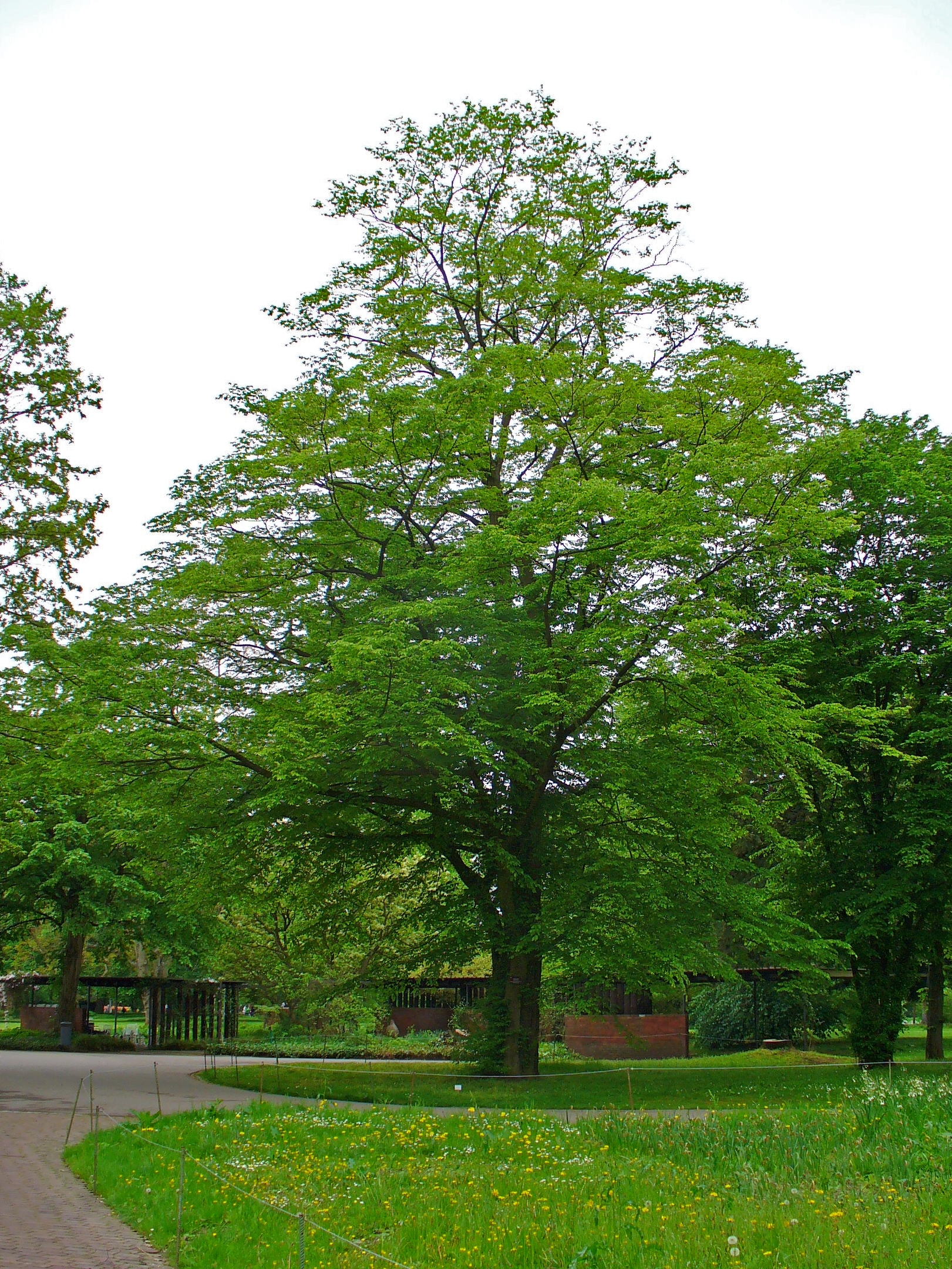
Hornbeam grows as an understorey tree in open oak woods and mixed forests throughout the country, most often at lower altitudes. Its bark is grey and smooth in youth, but with age it becomes fluted, as if muscular or sinewy – caused by spindle-shaped ridges running lengthwise along the trunk. This “muscular” effect is completely characteristic and cannot be confused with any other tree. Hornbeam wood is exceptionally hard – harder than oak – and was historically used for tools, mill wheels and chess pieces.
Small-leaved lime – Tilia cordata

The lime is the national tree of the Czech Republic and a symbol of the Czech landscape – but recognising it in winter without leaves takes a little effort. The bark of young limes is grey-brown and relatively smooth with shallow longitudinal grooves; on older trees the furrows deepen and the bark becomes darker and rougher, but it never reaches the roughness of oak bark. A typical winter feature is the buds – alternate, reddish brown and flattened, with 2–3 visible scales. Lime bark – more precisely its inner bast – has long been used to weave baskets, ropes and sacking; memorial limes in many Czech villages are protected as cultural heritage. If you are looking for original wooden gift boxes or candle holders made of natural wood, AMADEA offers products made from local woods, including lime.
The most common mix-ups when identifying bark
Even experienced foresters sometimes get it wrong. Here are three of the most common mistakes beginners make:
Comparison table of Czech tree bark
| Tree | Bark colour | Texture | Characteristic feature | Habitat in Czechia |
|---|---|---|---|---|
| Silver birch | White to cream | Peeling in strips | Black horizontal lenticels | Whole country, pioneer |
| English oak | Grey-brown to dark grey | Deeply furrowed | Hard, stone-like texture | Lowlands, middle altitudes |
| European beech | Silvery grey | Smooth, no furrows | Stays smooth for life | Hills, 400–1,200 m |
| Scots pine | Grey-brown below, orange above | Rough below, flaky above | Two-tone trunk | Sandy soils, lowlands |
| Norway spruce | Grey-brown | Small rounded scales | Resin drops on wounds | Mountains, spruce monocultures |
| Sycamore maple | Grey to grey-brown | Flakes off in plates | Plate-like flaking | Mountain forests, ravines |
| Hornbeam | Grey | Fluted, “muscular” | Spindle-shaped longitudinal ridges | Oak woods, lowlands |
| Small-leaved lime | Grey-brown | Slightly furrowed | Dark red flattened buds | Villages, mixed forests, middle altitudes |
Frequently asked questions about tree bark
How can you identify a tree by its bark in winter?
In winter, the bark, the shape of the trunk and the branching pattern are the only reliable features. Focus on the colour and texture of the bark, the presence of lenticels and the way the tree branches. For conifers, the needles that stay on the tree also help. A good field guide or nature app will help you with winter identification better than photos of trees in summer.
Why does the birch have white bark?
The white colour comes from betulin, which reflects sunlight and protects the tissues under the bark from temperature swings in winter. Betulin also has antimicrobial effects that protect the tree from fungal infections.
What is outer bark (rhytidome) and how does it differ from bark in general?
Bark is the general term for the protective layer of the trunk. The rhytidome is the dead outer part of the bark that forms on older trees as the outer layers die off. Young trees have smooth bark without a rhytidome; with age it cracks, flakes off or stays in hard plates.
Can tree bark heal?
Traditional medicine used the bark of many trees. Tannin-rich oak bark was used to stop bleeding and treat diarrhoea. Birch bark with betulin has anti-inflammatory properties. Willow bark contains salicin – the natural forerunner of aspirin. However, any medicinal use should always be discussed with a professional.
Where can I buy handmade products made from Czech wood?
At AMADEA you will find handmade chopping boards, candle holders, gift boxes and dozens of other products made from local woods – beech, oak, ash and birch. Everything is made in the Czech Republic.
🌳 Looking for a gift made of natural wood? At AMADEA you will find handmade products from Czech forests – from decorations to kitchen accessories.
Visit AMADEAAuthor: Martin Portych – specialist in wooden products, gift advice and shop content
Editorial policy: Our content is based on the day-to-day practice of the AMADEA shop, the real needs of our customers and a commitment to clear, useful and trustworthy information.