
Mid-September is the moment in the Czech Republic when the weather turns – it starts getting dark earlier and suddenly your home calls for something warmer. Yet autumn home decorations needn't cost almost anything. You will find most of the material on a walk, and you probably already have the rest at home.
Why natural materials work better than shop-bought sets
The answer is simple: because they are not perfect. Let us explain.
Autumn decorating has one trap: in the shops, orange plastic pumpkins and garlands of artificial leaves lie in wait. They look tempting on the shelf, but at home they look cheap – because the colours are too saturated and the surfaces too perfect to resemble anything truly autumnal.
Natural materials have the opposite problem – or rather, advantage. A dried grass is never quite straight, a pumpkin never has a perfect shape, and wood has a grain no one designed. It is precisely this irregularity that makes an interior cosy, which is why natural decorations never become tiresome so quickly.
The second advantage is practical. Dried plants and fruits last the whole season, and you can put most of them away and use them again next year. The wooden container that holds it all will last twenty years – in December you just fill it with evergreen sprigs instead.
🍂 Missing a base to arrange your dried plants in? Vases, lanterns and crates made from Czech wood – handmade in our sheltered workshop.
Browse decorations and accessoriesWhere to start in your home
You don't need to decorate the whole flat. On the contrary – two well-done spots make a bigger impression than ten half-hearted ones. Let's go through the four most rewarding.
The dining table: one still life instead of five small things
The table is the natural centre of most households and the first place where it makes sense to start. It is also the place where it is easiest to overdo things – and where overdoing them backfires fastest, because you eat at the table.
The most common mistake is scattering lots of small things across the table. The result looks messy and you have to clear it away at every meal. The exact opposite works: one concentrated still life in the middle or slightly to one side.
The base can be a wooden tray or a shallow crate in which you arrange two or three small pumpkins, a handful of chestnuts and a few rosehips. Add one candle for height and you're done. You can lift it all off in one go when you need to lay the table.
A rule that works: an odd number of elements and a maximum of three colours. Three pumpkins look better than four, two heights better than one.
The windowsill: against the light
Windowsills in Czech flats tend to be wide and empty for most of the year. In autumn that is a shame, because this is where the most striking decoration can be created with the least effort.
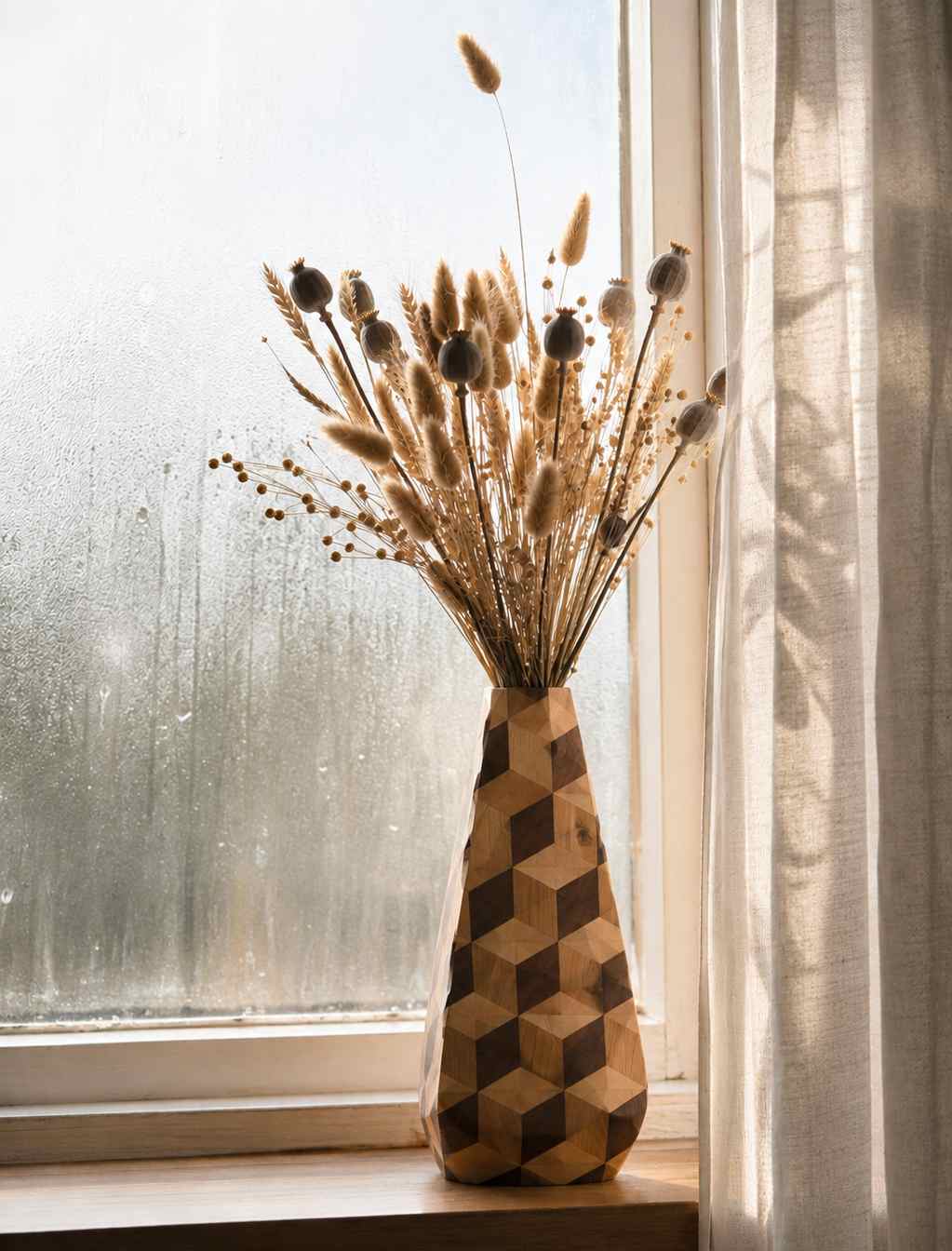
A windowsill has an advantage no other spot in the flat has – backlighting. Dried grasses, poppy heads and sprigs with berries against the window create silhouettes that look good even on a grey October day.
A tall wooden vase with dried grasses can carry the windowsill on its own. If you want more, place three containers of different heights side by side. Just watch out for the radiator under the window – dry hot air will make the dried plants brittle over the season and they will start to crumble.
The front door and hallway: the first impression
The entrance to your home is the place you see most often and think about least. Yet this is exactly where seasonal decoration fits best – you pass through several times a day and a small change reminds you of itself every time.
A wreath on the door is not just a Christmas thing. An autumn version made of dried grasses, leaves and rosehips works from September to the end of October and leads you smoothly into Advent.
In the hallway, a smaller touch is enough – a wooden sign with text, a bowl of chestnuts on the chest of drawers or one lantern by the mirror. The hallway is a place you only pass through, so less is more.
The living room: light matters more than decorations
It is worth pausing here on one thing most decorating guides skip. In October it is dark in the Czech Republic before six, and in December before four. So for the vast majority of the time you spend in the living room, you see it under artificial light – and what that light is like matters more than the number of decorations.
A single cold ceiling light can turn even a nicely furnished room into a waiting room. On the other hand, three warm point sources at different heights – a lamp on the chest of drawers, a candle on the table, a lantern on the floor – make the same room a place where you want to linger.
Autumn is mainly about it getting dark early. Well-placed warm light does more for the atmosphere than ten decorations. Wooden lanterns with a candle or an LED tealight, placed on the floor next to an armchair or on a bookcase, will transform a room in one evening.
Combine them with textiles – a blanket draped over the back of the sofa and two cushions in ochre or rust will do the rest. Wood and textiles are the two materials that soften a room fastest.
Tip before using fruits from the forest: Chestnuts, acorns and pine cones bring moisture into the house and often larvae too. Leave them spread out for a few days in a dry, ventilated place, or warm them briefly in the oven at a low temperature. You will spare yourself an unpleasant surprise when, a fortnight later, something starts crawling across your chest of drawers.
Colours that go together
With autumn decorating, the colour palette is what decides between cosy and cluttered. The good news is that you don't have to rely on taste – just copy what nature does.
The autumn palette is simple, because it is right outside your window. Stick to what you actually see outside, and the result will look natural.
| Shade | Where to find it | What to combine it with |
|---|---|---|
| Ochre and gold | Dried grasses, beech leaves | Light wood, linen, cream ceramics |
| Rust and terracotta | Rosehips, rowan berries, pumpkins | Darker wood, muted green |
| Brown | Chestnuts, acorns, pine cones | Practically anything – works as a base |
| Muted green | Moss, conifer sprigs, eucalyptus | Rust, cream, natural wood |
| Cream and white | Candles, textiles, dried flowers | Softens a composition that is too dark |
One warning about bright orange: it rarely works in a Czech home. Halloween orange doesn't match the colours of our autumn and looks out of place. Go for a more muted terracotta instead.
Three mistakes almost everyone makes
Decorations everywhere, a little at a time. The most common offence. One pumpkin on the windowsill, two cones on a shelf, a small wreath on a cupboard door, a candle on the fridge. Individually it makes sense; together it looks like clutter. Choose one or two spots in each room and concentrate everything there. Leave the rest empty – empty surfaces are what allow a decoration to stand out.
Too many colours. Autumn tempts you to reach for everything at once – an orange pumpkin, a red apple, a yellow leaf, green moss, a brown cone. Five colours in one still life is two too many. Stick to three and work with shades of the same colour rather than contrasts.
Mixing real with artificial. A dried grass next to a plastic leaf is a combination in which the plastic always loses – and drags the real thing down with it. Decide on one. If you need something that will last for years, choose wood, ceramics or glass. Materials that are true to themselves get on well with natural finds.
How to carry your decorations through to Advent
The clever thing about autumn decorations is that they can gradually turn into Advent decorations without you having to tear everything down in mid-November and start again. The trick is to keep the base and change only the contents.
The wooden tray that held pumpkins and chestnuts in September can be emptied in November and filled with evergreen sprigs, pine cones and dried orange slices. The lantern stays in the same place; just add some greenery around it. The vase with dried plants moves aside and an Advent candle holder takes its place.
The advantage is both practical and aesthetic. You save yourself one big clear-out, and the transition between seasons feels smooth rather than like flicking a switch. What's more, in September you buy things that will still serve you in December – and again next autumn.
The key is neutral containers in natural wood. A tray, a shallow crate, two or three lanterns of different heights and one taller vase. That is the whole basic kit with which you can handle autumn, Advent and spring. The seasonal character comes from the contents, which you gather outside or buy for a few euros.
What to gather on a Czech walk
You can collect the material for a whole season's decorations in one afternoon. In the floodplain forests along the Morava and Dyje rivers you will find rosehips and rowan berries, in the beech woods of Bohemian Paradise beautiful beech leaves, and on harvested fields leftover poppy heads and straw.
Gather in dry weather and only what there is plenty of – and of course not in protected areas where collecting is restricted. At home, spread everything out in a ventilated place and let it dry for a few days. Put leaves you want to keep flat between the pages of a book for a week.
In short. Autumn decorating rests on three things: concentrating on one or two spots in a room instead of scattered bits and pieces, sticking to three muted colours from nature, and sorting out warm light, because in October it is dark before five. You can gather natural materials for free, while wooden containers and lanterns serve for years – in December you just fill them with evergreen sprigs and you have Advent decorations.
A base that lasts for years


Frequently asked questions
How do I stop chestnuts and acorns from going mouldy?
Fruits from the forest contain moisture and often larvae. Leave them spread out for a few days in a dry, ventilated place, or warm them briefly in the oven at a low temperature. Only then use them in decorations and store them in a breathable container.
How long do autumn decorations made from dried plants last?
Dried grasses, poppy heads and fruits last the whole season and even several years, as long as they are not in direct sunlight or in steam. The colours gradually fade, but with natural materials that usually doesn't matter – on the contrary, it looks natural.
Which colours suit autumn decorations best?
Stick to what you see outside the window: ochre, rust, brown, muted green and cream. Don't add more than three shades. Natural wood works as a neutral base that ties all these tones together.
When does it make sense to start decorating for autumn?
In the Czech Republic, mid-September makes sense, when the weather turns and it starts getting dark earlier. The decorations then last until the end of October, when they flow naturally into the All Souls' Day period and then Advent.
Can autumn decorations be used again next year?
Dried plants, pine cones and poppy heads, yes – store them in a breathable box in a dry place, not in plastic. Pumpkins and fresh fruits, of course, not. Wooden containers, lanterns and vases serve for decades; only their contents change.
What wooden autumn decorations can I find at AMADEA?
In our sheltered workshop we make lanterns and candle holders, vases, crates, standalone decorations and signs with text. Everything is made from wood from Czech forests, so it pairs naturally with the dried plants and fruits you bring home from a walk.
🌳 An autumn that lasts for years. Lanterns, vases and decorations made from Czech wood – in December you just fill them with evergreen sprigs.
Go to decorations and accessoriesAuthor: Martin Portych – specialist in wooden products, gift advice and shop content
Editorial policy: Our content is based on the day-to-day practice of the AMADEA shop, the real needs of our customers and a commitment to clear, useful and trustworthy information.