
A children's room is the only room in a home that changes three times in ten years. Wooden decorations for a children's room have one major advantage over plastic – they outlast at least two of those three makeovers. And once they have served their purpose, they can be passed on rather than thrown away.
Why wood?
Before we get to safety and choosing, it is worth being clear about what wood actually brings to a children's room compared with more common materials.
The answer "because it is natural" is true, but not much use. There are several practical reasons, and it is worth knowing them specifically.
Wood is quiet and pleasant to the touch. It has lower thermal conductivity than plastic or metal, so it does not feel cold. Children notice this immediately – and for things they pick up every day, it matters.
It does not attract dust like textiles. A smooth surface is easy to wipe with a slightly damp cloth, so the room is easier to clean. For a child with allergies, this is one piece of the puzzle, not a solution – always discuss specific measures with your doctor.
It lasts longer than one child. A cheap plastic decoration lasts a year and then looks scuffed. A wooden name sign outlives a younger sibling and often ends up in a box of keepsakes.
It does not date visually so quickly. Trends in children's rooms change like everything else. Natural wood is a neutral base that works with everything – with pastel colours as well as with bolder textiles that you will replace in three years.
🌳 Furnishing a children's room? Decorations, magnets, pencil holders and fairy-tale characters made of Czech wood – handmade in our sheltered workshop.
Browse children's room decorationsSafety: four things to ask about
With children's things, looking nice is not enough. The following four points take two minutes when shopping, are worth checking for every product wherever you buy it, and cover the vast majority of risks associated with wooden items for children.
1. Surface finish
The most important point of all. For products intended for children, ask what the surface has been treated with and whether the finish is safe for items that may come into contact with the mouth. Small children put everything in their mouths, regardless of what the item is meant for.
The greatest caution is called for with cheap goods of unclear origin with conspicuous varnishes and no listed ingredients. With European manufacturers you will commonly see references to toy safety standards – if you are interested in a specific certification, ask the seller directly.
2. Size of parts by age
A key rule that can be summed up simply: anything that fits through a toilet roll tube is a risk for a child under three. Small magnets, tiny figures and removable parts belong in the room only later, or out of reach.
For younger children, choose wall decorations that are out of reach and larger pieces that cannot be put in the mouth. Save small items for school age, when they become bookmarks and fridge magnets.
3. Edges and surface
You can check this point before buying if you shop in person. If you order online, look at the detailed photos – the rounding of the edges is visible in good-quality pictures. And when the product arrives, feel it yourself first before giving it to your child.
Run your palm over the product. It should not catch anywhere, have a sharp edge or a splinter. Properly rounded edges are the quickest way to tell the difference between craftsmanship and sloppy production.
For things your child plays with every day, check the edges about twice a year. A worn spot only needs a gentle sanding.
4. Wall fixing
The most underestimated point. A decoration above a cot must be fixed so that it cannot be pulled down – and bear in mind that as soon as a child can stand, they can reach much further than you expect. Be especially careful with hanging decorations with cords, which do not belong within reach of small children at all.
Nothing unnecessary above the cot. The space directly above a sleeping child should be empty. Place decorations on a neighbouring wall or higher up, out of reach. The same applies to anything with a cord, ribbon or string – for children under three they pose a strangulation risk. It looks like excessive caution until something happens.
What suits which age
A children's room has the peculiarity that its occupant changes faster than the furniture. What works for a toddler today will look babyish in five years – and vice versa. So take the following breakdown as a guide when you are not sure what to choose, not as a rule.
| Age | What suits | What to avoid |
|---|---|---|
| 0 to 1 year | Wall decorations out of reach, a name sign | Anything small, cords, items above the cot |
| 1 to 3 years | Larger decorations, fairy-tale characters to look at | Small parts, magnets, sharp edges |
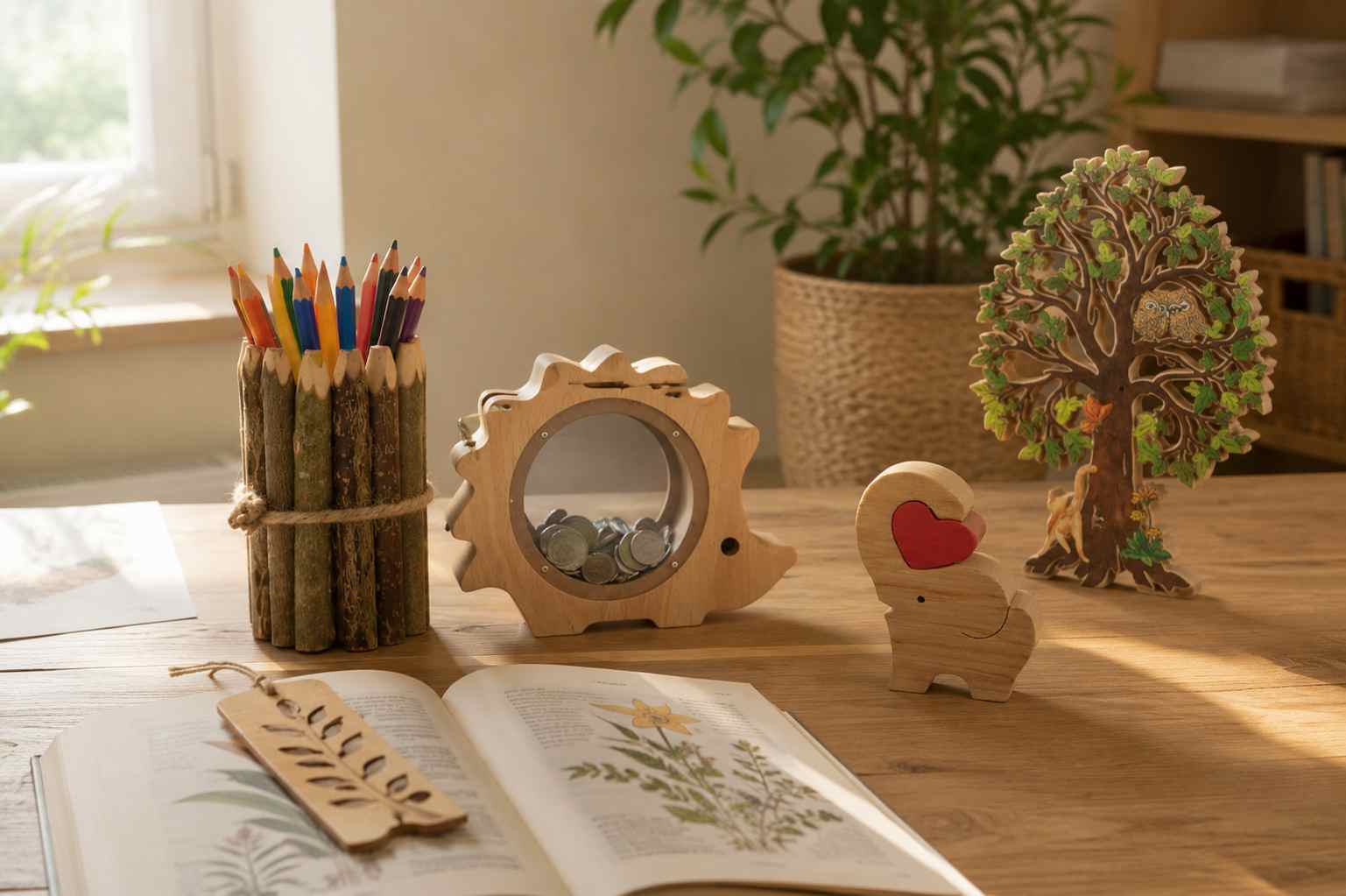
| 3 to 6 years | Magnets, a money box, a pencil holder, a name plate for the door | Very small items for children who put things in their mouths |
| 6 years and over | Bookmarks, keyrings, desk organisers, things they make themselves | Childish motifs the child has "outgrown" |
How to use wood in the room without it feeling heavy
The most common worry parents have is: will it look like a country cottage? It will not, if you stick to two things.
Give the wood space around it. Wood works as an accent, not as full wall cladding. A few decorations on a white wall look airy; ten pieces side by side are overwhelming. The same rule applies as in the living room – fewer, larger pieces look better than lots of small ones.
Combine it with colour in textiles. Bring colour into the room through bedding, a rug and cushions that you can easily replace in three years. Keep the wood in its natural tone as a permanent base. You will save yourself repainting furniture the moment your child decides that pink is no longer cool.
A final practical tip: a name plate for the door or a sign with a name is the cheapest change with the biggest effect. For a child it is a signal that the room really is theirs – and with siblings, incidentally, it also settles a few disputes.
Which wood suits a children's room
A question few people ask – and yet there are differences between wood species that show in a children's room.
Beech is the most common choice, and for good reason. It is hard, so it does not scratch easily, has a calm, even grain and a light tone that does not weigh down the room. For things a child handles every day, it is the most practical material.
Oak is even harder and more durable, but heavier and with a more pronounced grain. It is better suited to furniture and larger pieces than to small items a child carries around. In an older schoolchild's room it looks more grown-up, which is often a plus for a ten-year-old.
Maple is light, fine and almost without grain. Engraving shows up well on it, so it is great for name plates and decorations with a name. It is slightly softer than beech, so it is not ideal for items exposed to rough handling.
It is best to avoid softwoods such as spruce for small items for children – they dent easily and the edges wear sooner. They can, however, work for larger wall decorations that nobody handles.
How to combine wood with colours
Natural wood is a warm neutral, so it goes with practically everything. Still, some combinations work better than others. Light beech and maple go well with pastel tones, sage green, dusty blue and cream – the result feels airy and calm. Darker oak suits richer colours, such as mustard or brick red, which would get lost next to light wood.
What to avoid: combining many saturated colours at once. A children's room tends to be colourful in itself – toys, books, drawings on the wall. Wood works as a calming element there, not as yet another competitor for attention.
Involve your child in the choice
A final piece of advice that has nothing to do with materials, but works. From about the age of four, a child has a clear idea of what they like – and they value a room they helped shape more. This does not apply to major decisions such as furniture, but it certainly does to decorations.
Let them choose the motif for a name plate or come up with the text to be engraved on it. A five-year-old usually does not want anything complicated – their name and a favourite animal are enough. You can also make your own piece in the Create Your Own category, where you prepare the design together.
A practical side effect: things the child chose themselves usually survive the phase when everything "childish" disappears from the room. While teddy bears and toy cars go into a box at the age of eight, the name plate on the door stays.
In short. With wood in a children's room, three things matter most: ask about the surface finish, match the size of items to the child's age and firmly fix everything that hangs on the wall. Visually, restraint works – a few pieces of wood as a permanent base, with colour coming from textiles that are easy to change when your child's taste changes.
Selected ideas from our workshop


Frequently asked questions
From what age can children have wooden decorations in their room?
It depends on size and placement. Decorations hung on the wall out of reach are suitable from birth. Small items that a child could put in their mouth belong in the room only after the age of three – younger children risk inhaling or swallowing them.
Is wood hygienic in a children's room?
A smooth wooden surface is easy to wipe and, unlike textiles, does not attract dust, which makes cleaning easier. Studies suggest that bacteria survive less well on dry wood than on plastic, but hygiene depends above all on regular cleaning. Wipe wood with a slightly damp cloth – never soak it or put it in the dishwasher.
What should I watch out for with the surface finish?
For products intended for children, ask what the surface has been treated with and whether the finish is safe for items that may come into contact with the mouth. Avoid unknown varnishes and paints with no listed ingredients, especially on goods of unclear origin.
How often do wooden decorations in a children's room need treating?
Wall decorations practically never – it is enough to dust them every now and then. Items a child plays with and handles wear faster. Check their edges about twice a year and gently sand them if needed.
Can a child's name be engraved on a decoration?
Yes, many products can be engraved with a name, date of birth or a short message. You can prepare the design yourself in our online configurator. A name plate for the door is one of the most popular gifts for a birth or for moving into their own room.
What wooden products for children do you offer?
In our sheltered workshop we make children's room decorations, fairy-tale characters, magnets, bookmarks, pencil holders, money boxes and keyrings – you will find them all in the For Children section. Many of them can be engraved with the child's name.
🌳 A room that grows with your child. Wooden decorations, fairy-tale characters and accessories made of Czech wood – with the option of engraving a name.
Go to the For Children sectionAuthor: Martin Portych – specialist in wooden products, gift advice and shop content
Editorial policy: Our content is based on the day-to-day practice of the AMADEA shop, the real needs of our customers and a commitment to clear, useful and trustworthy information.